Courts Before the Club
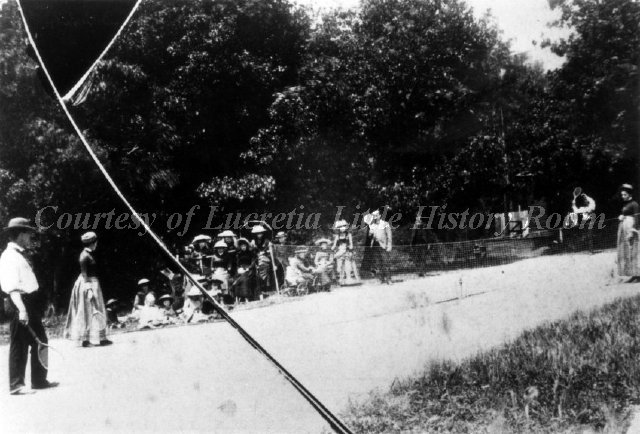
Tennis came to Mill Valley with the summer people. A Marin Independent Journal history of 2011 dates the town's tennis to as early as 1879, when the Blithedale Hotel, a former sanitarium and the town's first hotel, had courts that drew wealthy San Francisco families, Adolph Sutro's among them1. No newspaper of the 1870s read for this history mentions those courts, so the date rests on that article alone. A library photograph catalogued as about 1900 shows hotel guests at play on the Blithedale court2.
The game was then a social one, played on private lawns and hotel courts, and Marin's tennis was centred on San Rafael. In September 1893 the fall tournament at the Hotel Rafael drew two hundred spectators and “the full complement of the socially elect” to watch Bee Hooper take the women's championship from Susie Morgan, and the Hardy brothers keep the doubles cup for good3. The Marin Journal noted that only one of the three days had been real “lawn tennis” weather4.
Mill Valley's first named club appears six years later. In August 1899 the San Francisco Call reported a doubles match “on the Eastland Tennis Club's court, Mill Valley”, in which George McChesney and DuVal Moore of the Eastland club beat Spencer Grant and Moulton Warner of the West Side club; the club gave a dance at Grethill's Hall that evening5. The next summer the Eastland club held its first handicap doubles tournament “on the club courts at Woodside Inn”, with sixteen players entered, the Judah brothers and Max Rosenfeld among them6. Floyd Judah and Rosenfeld won a five-set match there that ended 10–8 in the fifth7. Where the Woodside Inn stood, and whether the Eastland court was the inn's or a private one beside it, the sources do not say. The club's name was probably taken from the Eastland family, whose James G. Eastland lived in Mill Valley in the 1890s8.
Mill Valley players were soon entering the big tournaments across the county. When the first open championship of California for men's singles was played at the Hotel Rafael on the Fourth of July 1901, the Marin Journal listed Paul Jones, DuVal Moore and Orville Pratt “of Mill Valley” among the entrants, alongside the Whitneys and the champion of the Hawaiian Islands9. The Call had predicted that the tournament's big September events would bring the best tennis ever played on the coast10.
The Billings Court
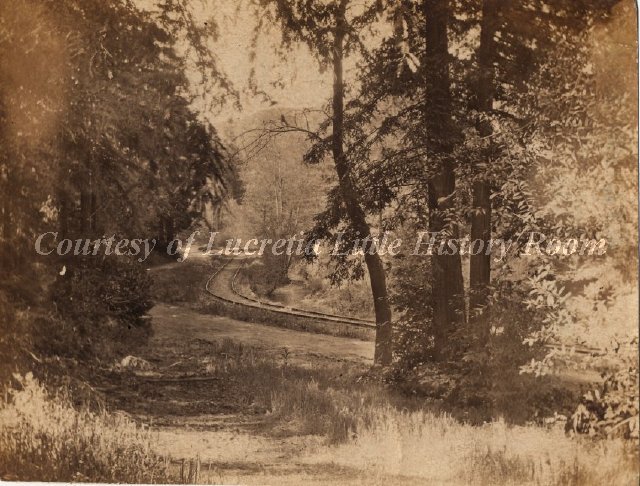
The court that mattered most before 1929 belonged to George and Maria Billings. The library's record says that the San Francisco couple built tennis courts in 1896 beside the Redwood Lodge, which they had built earlier, and moved to the lodge for good after the 1906 earthquake11. The lodge is the Billings-Keiler House at 160 Corte Madera Avenue12. A note on the back of one library print places the court below the tracks of the Mount Tamalpais railway: “Tamalpais RW track above Billings Tennis Court”11. When George E. Billings died in December 1929 the Record remembered him as a pioneer who had come to Mill Valley while it was still a sparsely settled forest13.
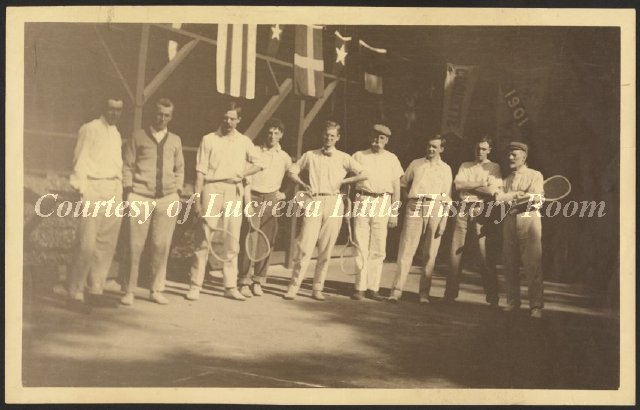
The Billings court drew the best players in the country. A library photograph of about 1914 shows nine men, several holding rackets, in front of a grandstand hung with flags. A newspaper clipping taped to its back, with a 1914 photograph of eight players, identifies the place as the Billings court in Mill Valley and names Samuel Hardy, R. Lindley Murray, John Strachan, William A. Marcus (spelled Lindly, Stachan and Marcu in the library's record), “Little Bill” Johnston, Clarence “Peck” Griffin, Roland Roberts and Maurice McLoughlin, “The Comet”14. The library notes that it is not clear whether the two pictures show the same men14. Johnston and McLoughlin were among the most famous American players of their day; the Mill Valley name in the group, William A. Marcus, was probably the Bill Marcus who would play on the Mill Valley Tennis Club's championship team of 193115.
A Court for the Playground
For people without a hotel or a private court, there was little. In February 1912 the “Girls' Dramatic Club”, the ten girls of the graduating class, gave an entertainment and dance at the schoolhouse “for the benefit of a tennis court for the Mill Valley playgrounds, in Boyle Park”17. The program ran from a piano solo to a scene from Uncle Tom's Cabin, and admission was 25 cents17. Whether that court was ever built is not recorded in the papers read for this history; the town's own lighted courts in Boyle Park did not come until 1938.
The high school was playing by then. A Marin Journal note of October 1919 announced the Tamalpais interclass tennis tournament18, and in November 1926 the Sausalito News reported that Tam had won the North Bay League tennis championship at the end of the fall matches19. Mill Valley men also played away. In June 1924 the Record proudly reported that A. N. Bagshaw and Oliver Sollom of Mill Valley had won a round of the men's doubles at Camp Curry in Yosemite, beating a pair from Ontario and San Rafael 6–0, 4–6, 6–220.
The First Mill Valley Tennis Club
The name Mill Valley Tennis Club is older than the club that holds it. In May 1919 the Record announced that a Mill Valley Tennis Club “has recently been formed” to give the town some sporting honours, since so far “honors in the field of sport have not particularly come our way”21. Its charter members were “Doc” Aten, “Bill” Donnan, “Stu” Bostwick, “Ted” McLewee, “Lou” and “Burnie” Marsh, “Sainty” St. Johnson and “Dave” Walker, with a very limited number of seasonal members to come21. The club bought the tennis court of Mrs. Clinton Folger on Bigelow Avenue and promised to put it in shape for the tournaments that would “undoubtedly eventuate”21. There was not a week in the previous year, the paper added, when tennis had not been possible in the valley21.
That first club seems to have lasted some years. A snippet from the San Anselmo Herald of December 1923 reports that “the Mill Valley Tennis Club leads the Marin County Tennis League”22. Only the search snippet has been read, so nothing more is known of that league. The 1919 “Stu” Bostwick was almost certainly Stewart A. Bostwick, who ten years later would be the first president of the club that still exists; no source says so in so many words.
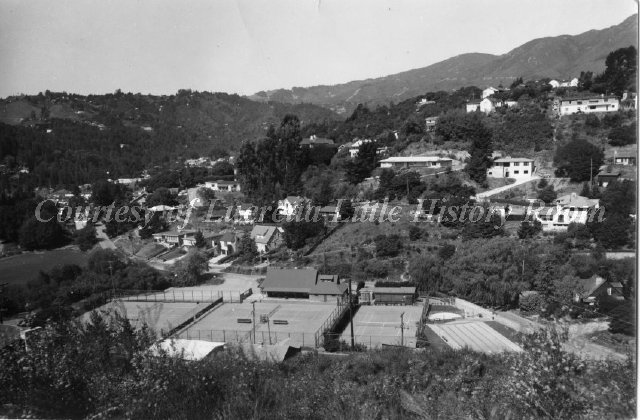
By the late 1920s the shortage of courts had become the town's tennis problem. The club's own history, written by a member for the Record in 1946, says that in the 1920s there were only about three private courts in Mill Valley16. Dr. Samuel Weiss and Stewart and Helen Bostwick were among a group who played on the John Finn court on Miller Avenue, and the group was so large that it often took a whole Sunday on the benches to get in two sets of doubles16. A 1960 retelling repeats the three courts and the Finn court23.
“it was frequently necessary to spend a whole Sunday on the benches to be able to play two sets of doubles”
Weiss was the best player in that crowd. According to the 1946 history he had won the New York World's public courts tournament in 1908, against more than a thousand entries, and after coming to San Francisco he had been a regular at the Golden Gate Park courts16. One Sunday late in the winter of 1929 he said he meant to buy a piece of land and build a court for himself, and he asked the Bostwicks to help him choose it16. Out of that errand came the idea of a small group building a second court beside his, and out of that, the club16.
On 26 April 1929 the Record announced that plans were “well under way” for a tennis club for Mill Valley and southern Marin, on a site already chosen, with two club courts to be built next to a private court that one of the organizers would build for himself24. A professional would teach at set hours each week, and anyone who wanted notice of the first meeting was to get in touch with Mr. or Mrs. Stewart Bostwick24. The next chapter begins with that meeting.
Notes to Chapter I (24 sources)
- Holly Woolard (column), “Tennis in Marin: County brimming with tennis history,” Marin Independent Journal, March 21, 2011 (saved copy research/web/000.html; link is a search for the page). view source ↗
- Mill Valley Public Library, Lucretia Little History Room, Guests playing tennis, Blithedale Hotel, circa 1900, object cmlpl_160. view source ↗
- San Francisco Call, Sept. 10, 1893. view source ↗
- Marin Journal, Sept. 14, 1893. view source ↗
- San Francisco Call, Aug. 7, 1899. view source ↗
- San Francisco Call, July 28, 1900. view source ↗
- San Francisco Call, July 30, 1900. view source ↗
- Marin County Tocsin, Sept. 14, 1895 (known from the CDNC search snippet only). view source ↗
- Marin Journal, July 4, 1901. view source ↗
- San Francisco Call, June 29, 1901. view source ↗
- Mill Valley Public Library, Lucretia Little History Room, Railroad tracks above Billings Tennis Court, date unknown, object 2018.001.457. view source ↗
- Mill Valley Public Library, Lucretia Little History Room, Tennis player at the Redwood Lodge, date unknown, object 2018.001.004. view source ↗
- Mill Valley Record, Dec. 20, 1929 (known from the CDNC search snippet only). view source ↗
- Mill Valley Public Library, Lucretia Little History Room, Tennis players, circa 1914, object MVU2941. view source ↗
- Mill Valley Record, April 24, 1931. view source ↗
- Mill Valley Record, Aug. 1, 1946. view source ↗
- Mill Valley Record, Feb. 2, 1912. view source ↗
- Marin Journal, Oct. 2, 1919 (known from the CDNC search snippet only). view source ↗
- Sausalito News, Nov. 13, 1926 (known from the CDNC search snippet only). view source ↗
- Mill Valley Record, June 28, 1924. view source ↗
- Mill Valley Record, May 10, 1919. view source ↗
- San Anselmo Herald, Dec. 7, 1923 (known from the CDNC search snippet only). view source ↗
- Mill Valley Record, Sept. 21, 1960. view source ↗
- Mill Valley Record, April 26, 1929. view source ↗
Four Courts and a Dressing Room
The club was put together by telephone. According to the history a member wrote for the Record in 1946, Helen Bostwick took up Dr. Weiss's idea of a second court with great enthusiasm, won the reluctant support of her husband, who thought it would be too much work, and began calling her friends1. A small committee worked out costs and financing: Charles W. Claudius, architect and engineer; Thomas C. Nelson, an attorney; Marvin Curtis, whom the history calls an idealist and promoter by nature; and Stewart Bostwick1. Curtis was the father of the swimmers Ann and Sue Curtis1. The site they wanted was kept quiet for fear the price would rise, and subscriptions were taken on the pretence of buying a different lot1.
By early May the plan had grown to two club courts and 27 people had subscribed1. On 9 May 1929 they met at the Old Mill School. The 1946 history says the meeting was sliding into gloom as the cautious members voiced their fears, until Curtis jumped up and gave an irresistible pep talk, and everyone present signed1. At a luncheon for the club's 25th anniversary in 1954 the members gave Helen Bostwick a standing ovation as the moving spirit of the founding, and recalled that the 9 May meeting had turned out to be the first directors' meeting2.
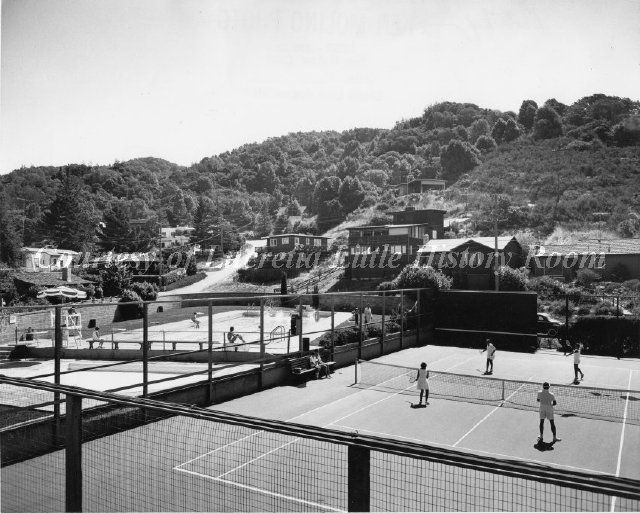
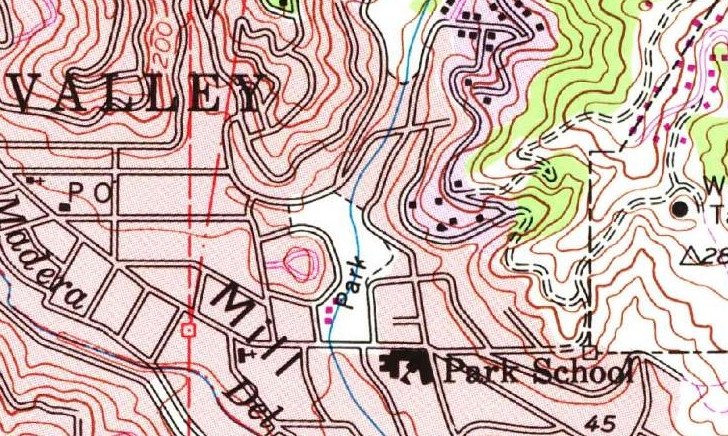
The Record's report of 17 May gave the details. The new organization would be called the Mill Valley Tennis Club. Its officers were S. A. Bostwick, president; Dr. S. Weiss, vice president; and C. J. Brockhoff, secretary and treasurer; and the directors included R. P. Connally, T. C. Nelson and M. Curtis Jr.4 A splendid site had been secured “near Boyle Park” and would be ready for play by 1 July4. Membership was limited to fifty, thirty had already joined, and a membership cost one hundred and fifty dollars, payable at fifteen dollars a month4. Three courts would be built with fences, stands, dressing rooms and showers, and there was room for two more courts and a clubhouse4.
The members were careful to keep their distance from the town's own recreation plans. When a community dinner was called that May to hear a Berkeley specialist on city recreation, its committee asked the Record to say that the plan had nothing to do with the tennis club, which was “a very creditable but strictly private affair”7.
Early in June the land was bought and contracts were let for three club courts and Dr. Weiss's own court1. Grading was well under way when the great fire of late June 1929 burned through the town. The homes of several members were destroyed, the 1946 history says, and town and club both suffered a severe setback1. The Curtis family's house on Summit Avenue was among those lost8. Work went on, and the courts were ready in the first half of August1.
The Record reported that they were informally opened on a Sunday early in August, when out-of-town guests praised them as remarkably fine9. The formal opening, with exhibitions by some of the world's best players, was put off until the first unit of the clubhouse could be built, and Frank Regan was appointed the club's professional, to come one day a week9. The surface itself made news; an Independent Journal history of 2011 says the courts were laid with a mechanical finisher normally used on highways, spreading the asphalt-concrete mix evenly and saving on upkeep10. The Sausalito town council was told in 1934 that the same builders, the Pacific States Construction Company, had built “the Mill Valley courts”, probably meaning the club's11.
The first club championship was decided on Labor Day, when Gail Warwick beat Dr. Samuel Weiss 6–1, 6–1, though the Record insisted every point was stubbornly contested13. The club sent Warwick, R. J. Greenberg, Carmen Maurer and Mrs. Stewart Bostwick to the state championships at Berkeley that September13. The juniors had their own tournament, and on a Sunday in September Norman Wright beat Douglas Smith 6–2, 6–3 to win the junior cup outright14.
The club filled at once. At a general meeting in September the members raised the limit to sixty, and every new place was taken; no more would be admitted, the officers announced, until there were enough names on the waiting list to pay for more courts15. That was the start of a waiting list that, in one form or another, has lasted ever since. Kurt Berndt, the Oregon state champion, replaced Regan as the club professional, teaching on Tuesday and Friday mornings and Wednesday afternoons15. In November the terrace and fully equipped dressing rooms were finished, with sixty members and a dozen names waiting, and the directors announced a program to culvert or fill the creek, add a court south of the terrace, light the south court for night play, build a main clubhouse and put a “swimming tank” at the west end of the property16. The members came from all over Marin, Bostwick said, and from Piedmont and San Francisco too16.
Stars on the New Courts
The formal opening came in February 1930. Bostwick announced that the club would keep open house for everyone in Marin County, and that the day's main event would be a doubles match among four of the best players on the Pacific Coast: Cranston Holman, the state champion; Gerald Stratford; Howard Kinsey, a former Wimbledon finalist who was then professional at the California Tennis Club; and Philip Neer17. By then the club had four courts, a large terrace, and dressing rooms with new lockers for men and women17.
“We had gambled and won so consistently that we thought nothing of gambling on February weather.”
The gamble paid. The 1946 history remembered the day as the most beautiful February 15th in history1; the Record's report a week after the match says it was played on the Sunday morning, which was 16 February. Kinsey and Neer beat Holman and Stratford in five sets, 6–1, 6–4, 2–6, 2–6, 6–4, before more than 200 spectators, and the paper thought it probably the most spectacular tennis ever played on Marin courts18. The club brochure of 2024, which tells the same story, says the crowd saw a calibre of tennis never before seen in Marin County19.
More visitors followed. Edith Cross, ranked third among American women, and Mrs. L. A. Harper, ranked fifth, came over to play Dr. Weiss and Ray Greenberg, the club's best pair, and lost in three sets20,21. That March the California State Tennis Association, meeting at the Bohemian Club, surprised the club's delegates, Bostwick, Claudius and Greenberg, by awarding Mill Valley a tournament of its own for the end of May: the Marin County Open21.
Ringers
The club also entered the Northern California interclub competition, for the first time, that April22. The 1946 history admits how. With only two capable players among the regular members, Dr. Weiss and Gail Warwick, and with the interclub rules “somewhat lax”, the club “organized a team of so-called athletic members”, chosen by Weiss and the professional Kurt Berndt1. Among them were Jack Cosgrove, Elmer Sewell, Ted Lindner, Elmer Gaetjen, Fred Haas and Wilmer Trainer1. The 2024 brochure calls them what they were: a few local “ringers”, recruited to supplement the members19.
The team swept through. It took all six singles from the Island City club of Alameda23, beat Stockton24, and won its division at the Berkeley Tennis Club by sweeping the doubles25. After an 8–1 win over the Emporium team, Supervisor Gardner told the Record that the club's run would bring Marin the kind of fame the Legion junior baseball team had won the year before26. On 18 May the club beat the California Tennis Club of San Francisco on its own courts, winning five of the six singles, to take the interclub trophy; the Record said it was the first tennis title any Marin organization had won in tournament play27.
They did it again in 1931. On 19 April the Mill Valley team won the Northern California interclub finals at the Berkeley Tennis Club and brought the cup home for the second year running; the team was Frank Dunn, Richard Blaskower, Fred Haas, Elmer Gaetjen, Dr. Samuel Weiss as captain, Wilmer Trainer, Gordon Jason and William A. Marcus28. The run ended in 1932, when the California Club beat Mill Valley in the semi-finals by taking all three doubles29.
The First Marin Championships
The first Marin County Tennis Championships opened on the club's courts on Thursday 29 May 1930, with more than a hundred players entered from across the state30. The Record called it the first event of its kind in Marin, and some matches had to be played on the Burlwood courts to fit them in31. The Chamber of Commerce gave a silver trophy32. The 1946 history admits that the club was handicapped, with nothing but four courts and an overcrowded dressing room, and that temporary lunch stands had to be built1.
Robert Sellers, the reigning Pacific Coast champion, beat Gerald Stratford in the men's singles final; Mrs. L. A. Harper won the women's singles; Phil Neer and Jim Davies took the men's doubles; and Golda Gross and Dorothy Weisel won the women's doubles30,19. The Record spelled the champion “Bob Seller”; the brochure, “Robert Sellers”30,19. Players and officials, the Record reported, called it the best-managed tournament ever held in the district30.
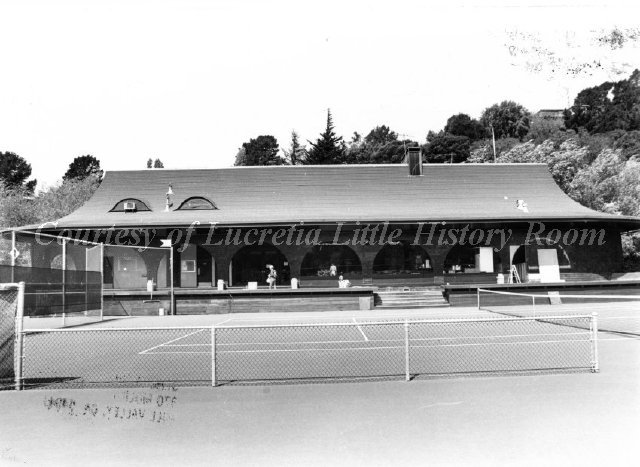
The club went on building. In June 1930 Bostwick announced a fifth court, then a sixth, and a clubhouse to be ready by the fall36; a fifth court was added that year, as later accounts agree37, but the sixth was never built. The first “all class” club tournament that August drew fifty-five entries38. The clubhouse came in 1931: a building with an assembly room, dressing rooms and lockers, at a cost of about $4,000, on Buena Vista39,40. Claudius designed it, and in 1946 the club made him a life member for having designed and built it41.
Then, in 1931, came the visitor the club would talk about for decades. The second Marin County Championships were set for late May, and Helen Wills Moody, “the World's Greatest Woman Tennis Player”, was to play exhibitions on the final Sunday47. Rain postponed her by a week, and many tournament matches had to be played off in San Francisco during the week48,49. On 31 May, before fans from all over the Bay, she lost a one-set singles to Wally Bates, 6–4, and, paired with Phil Neer, lost to Elmer and Mervyn Griffin, 6–0, 6–4; the Record said she was content to coast and show off her placements49. Gerald Stratford won the men's singles over John Murio, and Alice Marble shared the women's doubles title with Marion Hunt49. Admission was a dollar50. Afterward little Peggy Bostwick gave her a bouquet and she was the guest of honour at tea in the clubhouse49.
Notes to Chapter II (50 sources)
- Mill Valley Record, Aug. 1, 1946. view source ↗
- Mill Valley Record, June 22, 1954. view source ↗
- Mill Valley Record, Sept. 21, 1960. view source ↗
- Mill Valley Record, May 17, 1929. view source ↗
- Mill Valley Record, Aug. 8, 1946. view source ↗
- Mill Valley Record, Feb. 28, 1953 (known from the CDNC search snippet only). view source ↗
- Mill Valley Record, May 3, 1929. view source ↗
- Mill Valley Record, May 11, 1948. view source ↗
- Mill Valley Record, Aug. 9, 1929. view source ↗
- Holly Woolard (column), “Tennis in Marin: County brimming with tennis history,” Marin Independent Journal, March 21, 2011 (saved copy research/web/000.html; link is a search for the page). view source ↗
- Sausalito News, Sept. 21, 1934. view source ↗
- Mill Valley Public Library, Lucretia Little History Room, Vicinity of Mill Valley Tennis Club, 1930, object PHO0404. view source ↗
- Mill Valley Record, Sept. 6, 1929. view source ↗
- Mill Valley Record, Sept. 20, 1929. view source ↗
- Mill Valley Record, Sept. 27, 1929. view source ↗
- Mill Valley Record, Nov. 15, 1929. view source ↗
- Mill Valley Record, Feb. 14, 1930. view source ↗
- Mill Valley Record, Feb. 21, 1930. view source ↗
- Mill Valley Tennis Club, 2024 Marin Championships tournament brochure, with Jim Tighe's “History of the Marin Championships” (May 2024; mvtc.org PDF; text copy research/pdf/marin_champs_2024.txt). view source ↗
- Mill Valley Record, Feb. 28, 1930. view source ↗
- Mill Valley Record, March 7, 1930. view source ↗
- Mill Valley Record, April 18, 1930. view source ↗
- Mill Valley Record, April 25, 1930. view source ↗
- Mill Valley Record, May 2, 1930. view source ↗
- Sausalito News, May 16, 1930. view source ↗
- Mill Valley Record, May 16, 1930. view source ↗
- Mill Valley Record, May 23, 1930. view source ↗
- Mill Valley Record, April 24, 1931. view source ↗
- Mill Valley Record, April 22, 1932. view source ↗
- Mill Valley Record, June 13, 1930. view source ↗
- Mill Valley Record, May 30, 1930. view source ↗
- Mill Valley Record, May 2, 1930. view source ↗
- Mill Valley Record, May 10, 1935. view source ↗
- Mill Valley Record, Oct. 11, 1945. view source ↗
- Mill Valley Record, April 23, 1953. view source ↗
- Mill Valley Record, June 27, 1930. view source ↗
- Mill Valley Record, May 22, 1963. view source ↗
- Mill Valley Record, Aug. 22, 1930. view source ↗
- Mill Valley Record, Feb. 27, 1931. view source ↗
- Mill Valley Record, March 13, 1931. view source ↗
- Mill Valley Record, Feb. 14, 1946. view source ↗
- Tamalpais News, Sept. 4, 1931 (known from the CDNC search snippet only). view source ↗
- Mill Valley Record, Sept. 16, 1932. view source ↗
- Mill Valley Record, Sept. 22, 1933. view source ↗
- Mill Valley Record, Nov. 22, 1935 (known from the CDNC search snippet only). view source ↗
- Mill Valley Record, Aug. 22, 1939. view source ↗
- Mill Valley Record, May 22, 1931. view source ↗
- Mill Valley Record, May 29, 1931. view source ↗
- Mill Valley Record, June 5, 1931. view source ↗
- Mill Valley Record, May 29, 1931. view source ↗
Turkeys, Spaghetti and Hard Times
The club's second summer went well. Members kept joining until there were nearly a hundred, according to the history written for the Record in 1946, and the majority, carried away by the first year's success, outvoted a cautious minority and financed the clubhouse even as the Depression began to bite1. Charley Claudius ran the job himself, arriving before the workmen and staying two hours after they left, and it was finished at a cost that seemed unbelievable fifteen years later1.
After that the luck ran out. The 1946 history says the second Marin County Championships were ruined by an untimely rainstorm, with matches farmed out to courts in San Francisco and Berkeley, and that it was some years before the club found the courage to try again1. The history puts the rain in the spring of 1932, but the papers show it was the 1931 tournament, the one Helen Wills Moody saved, whose matches were moved to San Francisco2; probably the writer, fifteen years on, ran the two springs together. Either way, the open tournament lapsed.
The Depression then reached the club itself. Members resigned or went on the inactive list to save their dues, and meetings of the board became, the history says, very dreary events1. In 1935, after six years as president, Stewart Bostwick stepped down; he was followed by Bryan J. Marin, Frank Schroeder, E. J. Kickhofel, Russell Mills, P. Hawley Smith and Walter J. Mann, who led the club through the war1.
The club kept its spirits up with parties. There were tea dances for visiting naval officers in 19329, a “forty-nine camp” in 193310, Halloween and New Year's Eve dances, and the Spaghetti Festival every year; in 1935 it marked the club's sixth birthday11. The members organized county tennis as well. The Marin County Tennis Association, formed at the club in the summer of 1932, set out to classify and handicap the county's players so that ordinary members would enter tournaments without fearing the stars, and Bostwick and Claudius sat on its board12.
The great players still came, though less often. On a women's guest day in December 1932 Alice Marble, the Pacific Coast champion, beat Mrs. Anna Harper of the Wightman Cup team in three sets on the club courts13. In October 1934 the club brought Donald Budge, the twenty-year-old state champion, for an exhibition with John Murio, Walter Senior and his brother Lloyd Budge; the Record predicted that many thought he would soon be the world's greatest player14. In July 1935 Gerald Stratford and Phil Neer played Howard Kinsey and Larry Hall, with Dorothea Schwartz and Margaret Osborne in the mixed doubles, the first players of national standing at the club for some time15.
The club's teaching changed hands often. A professional named Gove offered junior classes in 193416. In 1935 the club professional was a woman, Mrs. H. B. Hoskinson, a well-known Marin teacher, who gave the members' children free classes twice a week17,18. In 1938 Russ Wood was the official professional, offering lessons to all Mill Valley residents19. Boy Scouts played their own county tournament on the club courts in 1934 for the Weiss-Hamilton trophy; one of the Scouts still in the draw in the third round was Harvey Klyce20.
City Courts in Boyle Park
Mill Valley finally got public courts in 1938. In January the city engineer presented plans for three tennis courts and handball courts, with night lighting, at what the Record called the new Mill Valley Recreational Park24. In February the council approved plans for the site, “opposite Park school”, and called for bids; about $7,700 would be spent on three tennis courts, four handball courts and lights25. Grading began in April and concrete was poured in May26,27. The courts stood on East Blithedale Avenue at East Drive, in Boyle Park28. Thomas Bagshaw, mayor through most of the 1930s, was later credited with them; his obituary of 1981 lists the tennis courts in Boyle Park among the works of his time on the council29.
The tennis club ran the opening. Arthur Kellett, for the club, engaged Gerald Stratford, Bud Chandler, Ed Amark, Harold Wagner, Virginia Wolfenden and Margaret Osborne for exhibitions on Sunday 19 June32. Hundreds came to watch, and the Record reported that the courts, which had cost $10,000 with the handball courts, were used by hundreds of children and adults in their first week, with night play every evening until midnight31. The Works Progress Administration supplied supervisors to teach and keep order31. The Record's review of the year listed the opening among the events of June 193833.
The new courts made the club's junior tournament bigger. That August, 46 players entered the junior events played to the finals on the club courts, and the Record credited the city courts with waking up interest34. Arthur “Junior” Schallock lost the boys' under-15 final to Dick Miller after turning his ankle, 6–3, 9–7; Harvey Klyce beat Conrad Caprin; Helen Arrigo won the girls' title34. The next summer Ralph Marchus, a WPA recreation teacher, gave free lessons at the municipal courts35.
The public courts brought public arguments. In December 1939 the parks commission, answering a written protest from the PTA that the rules were too hard on children, recommended striking the age rules and giving adults priority only on court number one36. The new rules also required tennis shoes without heels, shirts for men and boys, and no smoking while playing37.
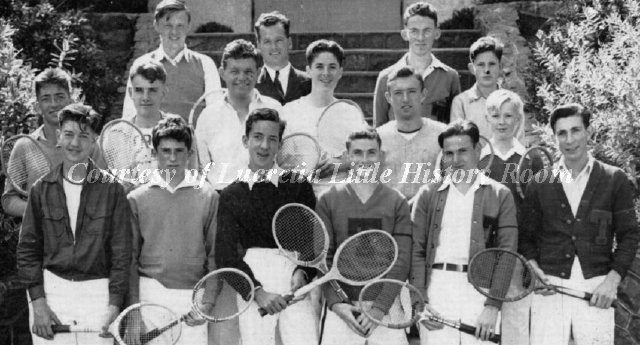
The high school, meanwhile, used the club. Tam's matches against Petaluma in 1938 and Napa in 1939 were played on the Mill Valley Tennis Club courts39,40, and in 1950 the Tamalpais News said the team would practise there “as it has in past seasons”41.
The Marin Open Returns
The county tournament came back to the club in July 1937, the first time in five years, the Record said; John Murio won the men's singles and Lou Gates the women's42. The open championships returned in May 1938, and the 1946 history counts that year as their revival1. Robert Harman of Berkeley beat Murio in the final and Elsie Gabel won the women's title; Frank Kovacs, winning the doubles with Norman Brooks, split his lip when he crashed into his partner43.
By 1939 the Record was calling Mill Valley the tennis capital of the state for the tournament's two weekends, with the overflow played at the new municipal courts45. Harold Wagner, seeded third, beat Henry Guilmette and then Ed Alloo for the men's title; Virginia Wolfenden beat Patricia Canning; Kovacs and Brooks won the doubles, and Canning and Kovacs the mixed46. In 1940 a nineteen-year-old left-hander from San Jose State, Ronald Edwards, won the men's singles and, with Margaret Osborne, the mixed, playing six matches on the last day47. Osborne took the women's singles, and Mill Valley families put up the visiting players in their homes48. In 1941 Pat Canning won three titles and Bill Crosby two49. In June 1942 Tom Brown, captain at the University of California, beat the favourite Crosby in the final, and Margaret Osborne won the women's singles 6–0, 6–050.
The club was respected in the game's government as well. In January 1940 its president, Edward Kickhofel, was elected to the board of the Northern California Tennis Association, and in 1941 Russell Mills joined him there51,52. In March 1940 dance music from the “lovely rustic clubhouse” went out on a Pacific radio network, as the club gave its first interclub dansant with Wolfenden and Canning as guests53. Early in 1941 the club, until then an association, was incorporated by the state as a nonprofit corporation54, and at its first annual meeting as a corporation Russell Mills, its best player, was elected president55.
The women of the club played their own championships. In October 1940 Elizabeth Kickhofel, the president's daughter and the county champion, beat Helen Arrigo, the junior champion, 6–2, 6–3 for the club's women's title56. In April 1941 the club's Chris Larsen and Helen Arrigo won the mixed doubles at Marin's first night tournament, played under the lights of the municipal courts57.
Wartime
The war thinned the club and dimmed the town's courts. Early in 1942 the lights on the municipal courts were turned off for the blackouts, and when they came back that summer they were to be kept under watch so that they could be put out quickly in an alert58. The club played army and navy teams in 194259, the Coast Guard's “Surf Riders” in 194360, and the officers' team from Hamilton Field in 194461. In April 1941, before Pearl Harbor, 120 women had crowded the clubhouse for a card party for British relief62.
The revival began in the summer of 1944. The 1946 history says that soon after the invasion of Europe the members sensed a change in public mood, started a little activity, and found new members waiting to join1. That July the club opened a draw doubles tournament to anyone in Marin, especially players who had given up the game in the past few years63. By November, President Walter J. Mann announced that 28 members had joined in ninety days, Helen Arrigo among them, and that of the many golf and tennis clubs in southern Marin in 1929, only two privately owned ones survived64. The 1946 history named them: the Mill Valley Tennis Club and the Lagunitas Club, and it put the survival down to low dues and the fact that there had never been an assessment1.
In June 1945, with the war in Europe over, the club's professional Jack Jossi arranged an exhibition by Virginia Wolfenden Kovacs and Patricia Canning Todd, both among the top ten in the national rankings, free to anyone who came65. That October the Spaghetti Festival was announced in mock-solemn style for its fifteenth year66. Servicemen came home, and many joined the club, the history says, as the logical place to renew old friendships1.
Notes to Chapter III (66 sources)
- Mill Valley Record, Aug. 8, 1946. view source ↗
- Mill Valley Record, June 5, 1931. view source ↗
- Mill Valley Record, Sept. 13, 1929. view source ↗
- Mill Valley Record, April 1, 1932. view source ↗
- Mill Valley Record, Sept. 22, 1933. view source ↗
- Mill Valley Record, June 16, 1933. view source ↗
- Mill Valley Record, Sept. 4, 1936. view source ↗
- Mill Valley Record, Sept. 25, 1936. view source ↗
- Mill Valley Record, May 6, 1932. view source ↗
- Mill Valley Record, Feb. 10, 1933. view source ↗
- Mill Valley Record, April 26, 1935. view source ↗
- Mill Valley Record, Aug. 26, 1932. view source ↗
- Mill Valley Record, Dec. 9, 1932. view source ↗
- Mill Valley Record, Oct. 26, 1934. view source ↗
- Mill Valley Record, July 5, 1935. view source ↗
- Sausalito News, May 25, 1934. view source ↗
- Mill Valley Record, March 29, 1935. view source ↗
- Mill Valley Record, July 12, 1935. view source ↗
- Mill Valley Record, April 22, 1938. view source ↗
- Mill Valley Record, April 27, 1934. view source ↗
- Mill Valley Record, Nov. 4, 1938. view source ↗
- Mill Valley Record, Nov. 19, 1937. view source ↗
- Mill Valley Record, Nov. 1, 1940. view source ↗
- Mill Valley Record, Jan. 14, 1938. view source ↗
- Mill Valley Record, Feb. 25, 1938. view source ↗
- Mill Valley Record, April 22, 1938. view source ↗
- Mill Valley Record, May 13, 1938. view source ↗
- Mill Valley Record, Nov. 25, 1943. view source ↗
- Mill Valley Record, Aug. 5, 1981. view source ↗
- Mill Valley Public Library, Lucretia Little History Room, Boyle Park tennis courts, date unknown, object MVU1046. view source ↗
- Mill Valley Record, June 24, 1938. view source ↗
- Mill Valley Record, June 10, 1938. view source ↗
- Mill Valley Record, Jan. 13, 1939. view source ↗
- Mill Valley Record, Sept. 2, 1938. view source ↗
- Mill Valley Record, July 14, 1939. view source ↗
- Mill Valley Record, Dec. 1, 1939. view source ↗
- Mill Valley Record, Dec. 5, 1939. view source ↗
- Mill Valley Public Library, Lucretia Little History Room, Tamalpais High School tennis team, 1941, object 2023.001.022. view source ↗
- Mill Valley Record, Oct. 7, 1938. view source ↗
- Sausalito News, March 30, 1939. view source ↗
- Tamalpais News, March 10, 1950 (known from the CDNC search snippet only). view source ↗
- Mill Valley Record, July 9, 1937. view source ↗
- Mill Valley Record, May 27, 1938. view source ↗
- Mill Valley Public Library, Lucretia Little History Room, Tamalpais High School tennis player, date unknown, object 2023.001.023. view source ↗
- Mill Valley Record, April 28, 1939. view source ↗
- Mill Valley Record, May 9, 1939. view source ↗
- Mill Valley Record, June 18, 1940. view source ↗
- Mill Valley Record, June 18, 1940. view source ↗
- Mill Valley Record, June 17, 1941. view source ↗
- Mill Valley Record, June 16, 1942. view source ↗
- Mill Valley Record, Jan. 19, 1940. view source ↗
- Mill Valley Record, Jan. 21, 1941. view source ↗
- Mill Valley Record, March 19, 1940. view source ↗
- Mill Valley Record, Feb. 4, 1941. view source ↗
- Mill Valley Record, Feb. 7, 1941. view source ↗
- Mill Valley Record, Oct. 15, 1940. view source ↗
- Mill Valley Record, April 29, 1941. view source ↗
- Mill Valley Record, July 31, 1942. view source ↗
- Mill Valley Record, May 15, 1942. view source ↗
- Mill Valley Record, Oct. 14, 1943. view source ↗
- Mill Valley Record, Aug. 24, 1944. view source ↗
- Mill Valley Record, April 8, 1941. view source ↗
- Mill Valley Record, July 13, 1944. view source ↗
- Mill Valley Record, Nov. 2, 1944. view source ↗
- Mill Valley Record, June 28, 1945. view source ↗
- Mill Valley Record, Oct. 11, 1945. view source ↗
A Family Club
In the summer of 1946 the Record asked a member to write the club's history, calling it one of the oldest private “institutions” in the county, one that had entertained Helen Wills Moody, Ellsworth Vines and Don Budge1. The two instalments that followed are the main source for the club's first years, and the second ended in a mood of quiet pride. The courts had been resurfaced a few months earlier, the bank balance was healthy, and an insurance appraisal had valued the property, built in 1929 and 1930 for $15,000, at $40,000 to $50,0002. The club had been founded, the writer said, for families of moderate means2.
The next project was the “swimming tank” the founders had sketched in 19293. That August the directors adopted a financing plan worked out by a committee under Gerry Misner: a hundred “swimming” memberships at $100 and about a hundred and fifty “proprietary” memberships at $150, with no special assessment4. The club was already the largest tennis club in the county, the Record said, with five newly resurfaced courts, a clubhouse, a bar and dressing rooms4. An architect's drawing showed the pool, bathhouses and a wading pool beside the clubhouse, in the De la Casa, Buena Vista and Elm area5. Stewart Bostwick, now club secretary, explained that many inquiries had come from families with children4.
By November all hundred proprietary memberships were sold and more than $10,000 had been pledged6. In March 1947 the plan was enlarged to a regulation 30-by-75-foot pool, and in April the club let a $16,000 contract to Minton and Kuban of San Francisco7,8. The pool went on a lot beside court 5, bordering Del Casa Drive, bought the previous fall for $2,1008. The Record said it would be the only semi-public pool of its kind in southern Marin8.
The first unofficial swim came at the end of August 1947, with the children shrieking in their own wading pool next door10. With the pool, a member wrote, the tennis club had become very definitely a family club10. The engineering committee of trained engineers among the members had supervised the building, and Thomas Lunde had done all the contracting without pay10. The formal dedication waited until May 1948, when Bostwick, the first president, described how Marvin Curtis had started the club, and Curtis's daughters Sue and Ann gave a water ballet; Ann Curtis, the Record noted, had won 27 national championships11.
The pool remade the club's week. From September 1947 every Tuesday was Ladies' Day, with tennis, swimming, bridge and lunch, and a matron to watch children at the wading pool14. The club's swimming meets began in 1947 and soon grew beyond the membership. By 1952 the club held a meet sanctioned by the Pacific Association of the A.A.U., with more than 300 swimmers entered from as far as Portland, among them the national champion Phebe Cramer13. Bill Kennedy, the club professional in the early 1960s, told the Record that the pool was among the first in California to be built in conjunction with a tennis club, though he rarely swam himself because it loosened the muscles15.
Not every plan worked. In April 1949 Assemblyman Richard McCollister of Mill Valley introduced a bill to allow the club a liquor licence; the assembly defeated it within two weeks16,17. An Independent Journal history of 2011 says the club was the first private club in California to receive a liquor licence18; if so, it came later than 1949, and when is not recorded in the papers read for this history.
The Marin Open's Best Years
The Marin Open came back after the war and became one of the main events of the northern California season. In 1948 the Record said it was considered the third largest tournament in northern California, played on the club's five courts and two of the three municipal courts19,20. Sam Match, the third seed, upset Nick Carter and Ed Moylan to win the men's singles that year, and Dorothy Head kept the women's title by beating Virginia Kovacs, 11–9, 6–321. In 1949 the club professional, Hal Wagner, trained ball boys for the tournament for the first time22.
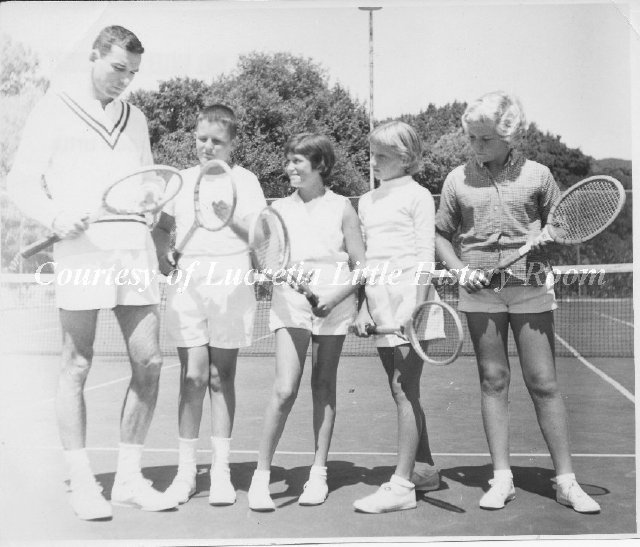
The winners were the leading players of the Bay. Harry Likas, the 1948 intercollegiate champion, and Virginia Kovacs won the singles in 195024. In 1951 Art Larsen, the national champion, played an exhibition against the state junior champion Jerry DeWitts, and Nick Carter beat Ellis Slack for the men's title on windblown courts25,26. In 1952 the draw included Tom Brown, the former Davis Cup player and Wimbledon finalist27. When Brown beat Carter in the 1953 final, 2–6, 6–3, 6–3, he was given for keeps the three-time-winner trophy, a large sterling bowl that had been in competition since 1935; the Record said he had won it in 1952 as well28.
By the mid-1950s the event was the Mill Valley Tennis Club Invitational, played over two weekends. In 1955 Brown, just crowned state champion, was seeded first; among the women were two sixteen-year-olds, Mimi Arnold and Mary Ann Mitchell29. In 1958 the semi-finalists included Brown, Cliff Mayne and Whitney Reed, and the quarter-final between Reed and Bill Crosby had the fans in an uproar30. The next year two Davis Cup players were promised for the invitational31.
The club's own members did well too. Elizabeth Loeck drove east in June 1949 to play nine tournaments, including the national championships at Forest Hills, and came back after 10,000 miles having won a doubles title at Harrisburg32,33. Howard Morehouse of San Rafael won the club singles in 1948, and Phil and Bob Seymour, two brothers from Ross, were among its best players for the next fifteen years34,35. In 1955 the Smith brothers, Phil and Gordon, took four titles between them at the Marin junior tournament36.
Juniors and the Wightman Cup
The postwar club was full of children. From 1950 its girls played in the junior Wightman Cup, a team competition for girls named after the women's international cup that Mrs. Wightman of Boston had given in 1919, and in 1952 the club's team had been runner-up the year before37,38,39. In February 1953 Mrs. Wightman herself, visiting her daughter in Mill Valley, was the guest of honour at a luncheon at the club for the girls of the squad, and demonstrated her technique to them38. That spring so many members' children turned out that the club set aside two days a week for junior tennis and gave the juniors court 4 on Saturday mornings40.
The club's surface was renewed more than once. In August 1953 the courts were rebuilt, and the members were invited to play at the California Tennis Club in San Francisco while the work went on47; the reopening party christened a new terrace overlooking the courts48. The courts were resurfaced again in 195649. Live-in caretakers had an apartment in the clubhouse50.
Twenty-Five Years and More
The club marked its 25th anniversary in June 1954 with a women's luncheon, at which Mrs. Hugh Lancaster told the club's story and the members gave Helen Bostwick a standing ovation51. The guests of honour were the wives of early board members, and the centrepieces were silver tennis rackets51. Stewart Bostwick had died the year before52.
In September 1960 the Record printed a short history with a photograph of the club about 1929, noting the absence of trees and houses around it55. It reported that after Dr. Weiss's death the club had bought his private court, and that the club had about 215 family memberships, with Melvin Klyce as president55. The professional then was Bill Kennedy, a former insurance broker and past president of the Northern California Tennis Association, who had replaced Hal Wagner15. In 1962 he described a club owned by some 225 Mill Valley families, where newcomers waited nine or ten months for a playing membership because court time was short at weekends15. He ran the shop, strung rackets and coached the club's junior Wightman and junior Davis Cup teams15.
“within reach of a lusty foul tip from the Boyle Park Little League diamond”
For its 35th birthday in June 1963 the club held a costume party in the style of the 1920s; two vintage cars collected the widows of two founders, Mrs. Stewart Bostwick and Mrs. Charles Claudius, and brought them to the clubhouse56. The Record counted more than 200 members and said Robert Hill was the club's 22nd president56. That September Hill also won the men's singles, Alice Reeve the women's, and Phil and Bob Seymour the doubles, with the charter member Walter Mann presenting the cups57. Kennedy left in June 1965 for Golden Gate Park; his wife Pat, who had written the members' newsletter, was thanked by the women's group58. Lou Lucchesi, a San Francisco recreation director who had played baseball for the Brooklyn Dodgers' organization, took over as part-time professional59.
Notes to Chapter IV (59 sources)
- Mill Valley Record, Aug. 1, 1946. view source ↗
- Mill Valley Record, Aug. 8, 1946. view source ↗
- Mill Valley Record, Nov. 15, 1929. view source ↗
- Mill Valley Record, Aug. 15, 1946. view source ↗
- Mill Valley Record, Aug. 15, 1946. view source ↗
- Mill Valley Record, Nov. 14, 1946. view source ↗
- Mill Valley Record, March 7, 1947. view source ↗
- Mill Valley Record, April 15, 1947. view source ↗
- Mill Valley Public Library, Lucretia Little History Room, Mill Valley Tennis Club, circa 1955, object 2018.001.308. view source ↗
- Mill Valley Record, Sept. 9, 1947. view source ↗
- Mill Valley Record, May 11, 1948. view source ↗
- Mill Valley Record, Dec. 31, 1948 (known from the CDNC search snippet only). view source ↗
- Mill Valley Record, July 31, 1952. view source ↗
- Mill Valley Record, Sept. 12, 1947. view source ↗
- Mill Valley Record, May 16, 1962. view source ↗
- Mill Valley Record, April 12, 1949. view source ↗
- Mill Valley Record, April 26, 1949. view source ↗
- Holly Woolard (column), “Tennis in Marin: County brimming with tennis history,” Marin Independent Journal, March 21, 2011 (saved copy research/web/000.html; link is a search for the page). view source ↗
- Mill Valley Record, Feb. 10, 1948. view source ↗
- Mill Valley Record, May 11, 1948. view source ↗
- Mill Valley Record, June 8, 1948. view source ↗
- Mill Valley Record, May 27, 1949. view source ↗
- Mill Valley Public Library, Lucretia Little History Room, Tom Brown teaching tennis to children, Circa 1950's, object 2019.001.274. view source ↗
- Mill Valley Record, June 2, 1950 (known from the CDNC search snippet only). view source ↗
- Mill Valley Record, May 24, 1951. view source ↗
- Mill Valley Record, June 7, 1951. view source ↗
- Mill Valley Record, May 22, 1952. view source ↗
- Mill Valley Record, June 2, 1953. view source ↗
- Mill Valley Record, June 2, 1955. view source ↗
- Mill Valley Record, June 19, 1958. view source ↗
- Mill Valley Record, June 11, 1959 (known from the CDNC search snippet only). view source ↗
- Mill Valley Record, June 21, 1949. view source ↗
- Mill Valley Record, Sept. 23, 1949. view source ↗
- Mill Valley Record, Aug. 10, 1948. view source ↗
- Mill Valley Record, July 22, 1947. view source ↗
- Mill Valley Record, Sept. 1, 1955. view source ↗
- Mill Valley Record, July 28, 1950 (known from the CDNC search snippet only). view source ↗
- Mill Valley Record, Feb. 3, 1953. view source ↗
- Mill Valley Record, Aug. 14, 1952. view source ↗
- Mill Valley Record, April 9, 1953. view source ↗
- Sausalito News, Aug. 1, 1959. view source ↗
- Mill Valley Record, Aug. 10, 1960. view source ↗
- Mill Valley Record, Aug. 23, 1961. view source ↗
- Mill Valley Record, July 27, 1977. view source ↗
- Mill Valley Record, June 26, 1991. view source ↗
- Mill Valley Record, June 6, 1979. view source ↗
- Mill Valley Record, Aug. 14, 1953. view source ↗
- Mill Valley Record, Aug. 27, 1953. view source ↗
- Mill Valley Record, Nov. 15, 1956. view source ↗
- Mill Valley Record, Feb. 3, 1953. view source ↗
- Mill Valley Record, June 22, 1954. view source ↗
- Mill Valley Record, Feb. 28, 1953 (known from the CDNC search snippet only). view source ↗
- Mill Valley Public Library, Lucretia Little History Room, The Mill Valley Tennis Club, date unknown, object 2018.001.314. view source ↗
- Mill Valley Record, Aug. 11, 1953. view source ↗
- Mill Valley Record, Sept. 21, 1960. view source ↗
- Mill Valley Record, May 22, 1963. view source ↗
- Mill Valley Record, Sept. 11, 1963. view source ↗
- Mill Valley Record, June 16, 1965. view source ↗
- Mill Valley Record, July 7, 1965. view source ↗
Nationals on Manor Drive
For a dozen years from the mid-1960s the best players over thirty-five in the United States came to Manor Drive every June. The club's 2024 tournament brochure says that the National Men's 35 Championships came to the club in the early 1960s through the efforts of Howard Morehouse and stayed until 1977, drawing nationally ranked players from all over the country1. The earliest report found is from June 1966, when the Record wrote that Mill Valley would be the tennis capital of the country that week; the club was hosting the National Men's 35 Hardcourt Championships, and its “handsome new clubhouse on Manor Drive” was ready, with no admission charged2. Morehouse was tournament chairman, and the club's own second senior men's championship ran alongside2.
The 1967 tournament was the ninth annual national championship of its kind sanctioned by the United States Lawn Tennis Association, with 52 singles entries and 26 doubles teams4. Whitney Reed, who would not turn 35 until August, was top seed because the defending champion, Vladimir Petrovic, was out with a bad knee; the seventh-seeded doubles pair, Merrill Ehmke and Bill Richardson, were ranked first in the country4. Petrovic had beaten Joe Woolfson in the 1966 final4. Cliff Mayne won in 1970, the Record reported, in a tournament then in the twelfth year of its history5.
In 1971, for the first time, the tournament offered prize money: a fund of $1,000, with $300 for the singles champion, in the club's announcement in May, and $1,050 by the time play began6,7. A $1.50 admission was charged on the final weekend7. Mayne was seeded first that year, ahead of Petrovic, Reed and Don Kierbow7. Kierbow came back in 1972 as the defending champion, top-seeded in singles and in doubles with Reed8. In 1973 the fifteenth tournament drew 80 entrants for $2,000 in prizes, co-sponsored by the Plexipave company, with Dick Dresel as chairman and Jim Landin of Colorado defending the singles title9.
The club's own junior hardcourt tournament went on through the early 1960s11,12, and its members kept turning up in the county's results. In 1977 an eleven-year-old Mill Valley boy seeded fourth in the Pacific Coast junior tournament at Belvedere was studying under the club's professional, Gordon Smith13.
Boyle Park: Five Courts and a Fee War
The town's public courts went through a long argument in these years, about who could use them and who should pay. In 1964 the parks commission gave Mill Valley residents the right to ask non-residents to leave whenever they wanted a court14. In 1967 it recommended charging 25 cents an hour to residents and 50 cents to everyone else in the summer15. Tam High's home matches had moved to the “Mill Valley City Courts” by 196116, and the city recreation department's tennis classes, run by John Garber, drew 145 pupils in 196517.
In 1969 Garber told the city council that the three courts on East Blithedale were overcrowded: five years earlier 70 children had signed up for summer lessons, the year before more than 20018. The Tam High courts, he said, were sloping, poorly surfaced and badly windswept, so that even the school team played its matches on the city's courts18. Players brought a petition with more than 500 names asking for two new courts18, and the council voted 3–2 to set aside $5,000 if the players raised the rest19. That autumn the parks director proposed limiting the courts to residents with a $1 key card20.
The restrictions came in 1972. Weekend play at Boyle Park was limited to residents with a free residency card, doubles had priority, a supervisor collected $1 per court per hour, and one court was set aside for teenagers21,22. In 1973 Garber, under the name of Garabedian Productions, offered to build two more courts, a pro shop and a health bar if the city would make him its tennis professional and buy the project back over ten years23; the city attorney said the plan as written was illegal, and the council shelved it24. In 1974 the commission voted to bar non-residents from the city's tennis lessons; the council reversed what one member called a “1 a.m. vote” a few weeks later25,26.
The two new courts were built at last in 1975. The council let a contract for $29,277.78 to W. R. Forde Construction in May27, and the courts were dedicated at 8 a.m. on the Fourth of July with a doubles match between the mayor and a council member and the parks commission's chairman and a partner28. Racket decals for residents replaced the cards29,30. A private developer's offer to build twelve courts on four acres of city land in exchange for a fifteen-year lease was turned down flat in 197631.
The fee war came with the budget cuts that followed Proposition 1335. In the summer of 1978, ordered to make the five courts pay for themselves, the city first set a $3 hourly charge and then, after protests, a $50 annual pass for residents, $60 for non-residents and $30 for juniors and seniors36,37. Hardly anyone bought one. By October only 81 seasonal passes had been sold, and the parks director estimated that as many as 40 percent of the players had none; one commissioner said the commission had “blew it”38,39. Players complained that the courts were being run like a private country club40. In January 1979 the city made tennis free again until July, when a lower fee would take effect41.
The answer was a professional. In June 1979 the council gave the job to two teaching pros, Glen Pritzker of Mill Valley and Michael Johnson, trading as Racketwork, who would collect the fees, maintain the courts and run lessons in return for the right to teach privately and open a stand35. By August the parks director reported that things were going very smoothly42. Ed Fuchs, “Mr. Ed”, taught at Boyle Park for 25 years before he stepped down in 199343, and Chris Reiff ran the city's adult classes in the 1990s44. In 1991 Inside Tennis magazine rated the Boyle Park courts among the best in the Bay Area45.
Boyle Park's players also formed teams of their own. The Tam Booster tournament, first held on the five Boyle Park courts in April 1976 to raise money for Tam High athletics, became an annual event46,47. Tam High's teams went on using both sets of public courts. In 1978 the girls' coach, Pam Dagley, who had led the boys to first place in the MCAL in 1976, took a young team into the season; its first match was split between Boyle Park and Tam's own courts and lost on a tie-breaker in the fourth doubles48,49. In 1998 a Herald contributor described the Mill Valley Players of Boyle Park, a women's league team formed in 1995 by working women and mothers, which had climbed from last place to a winning record and the USTA sportsmanship award50. The Boyle Park Bombers, a women's team at the 4.5 level captained by Bev Lombard, won the USTA/Volvo league for a second straight year in 198951.
The Marin Seniors
The tournament that would become the club's signature began in 1977. According to the 2024 brochure, Bob Seymour helped the club start the Marin Seniors Tournament that year, and it has been held annually ever since1. The Independent Journal wrote in 2026 that the club's long record of drawing national talent had prompted Seymour to start it10. Seymour was a club member of long standing: as a University of California player he had dominated the club's tournament in 1947, and with his brother Phil he won the men's doubles in 196352,53.
In 1991 the Record's columnist Marjorie Mahl described the county's crowded tournament calendar and the senior championships at the Mill Valley club, and the club's teams were in the thick of the United States Tennis Association leagues; its men's 3.5 team lost a district title on the count of sets lost, 15 to Richmond's 1455,56. Gordon Smith, the club's professional in 1977, was by 1991 directing a senior professionals' tournament at Harbor Point with Rosie Casals13,55.
The club ended the century with a new professional. In February 1999 Polo Cowan of Lima, Peru, ranked fourth in the United States in the men's 35s and once as high as 300th in the world, became director of tennis and started a junior program the club had been without58. The club manager, Ishmael Assem, told the Herald that everybody liked him58. That September the Harbor Point club in Mill Valley held a celebration of the Davis Cup's hundredth year, organized to honour Vic Seixas, a Mill Valley resident and member of the International Tennis Hall of Fame with 15 Grand Slam titles59.
Notes to Chapter V (59 sources)
- Mill Valley Tennis Club, 2024 Marin Championships tournament brochure, with Jim Tighe's “History of the Marin Championships” (May 2024; mvtc.org PDF; text copy research/pdf/marin_champs_2024.txt). view source ↗
- Mill Valley Record, June 8, 1966. view source ↗
- Mill Valley Public Library, Lucretia Little History Room, Mill Valley Tennis Club, circa 1980, object 2018.001.321. view source ↗
- Mill Valley Record, June 21, 1967. view source ↗
- Mill Valley Record, June 24, 1970 (known from the CDNC search snippet only). view source ↗
- Mill Valley Record, May 19, 1971. view source ↗
- Mill Valley Record, June 16, 1971. view source ↗
- Mill Valley Record, June 21, 1972. view source ↗
- Mill Valley Record, June 20, 1973. view source ↗
- “Tennis: Clubs gearing up for 50th edition of Marin Championships,” Marin Independent Journal, April 25, 2026 (saved copy research/web/005.html; link is a search for the page). view source ↗
- Mill Valley Record, Aug. 24, 1960. view source ↗
- Mill Valley Record, Aug. 23, 1961. view source ↗
- Mill Valley Record, July 27, 1977. view source ↗
- Mill Valley Record, June 24, 1964. view source ↗
- Mill Valley Record, June 14, 1967. view source ↗
- Mill Valley Record, March 8, 1961. view source ↗
- Mill Valley Record, July 14, 1965. view source ↗
- Mill Valley Record, May 21, 1969. view source ↗
- Mill Valley Record, May 28, 1969. view source ↗
- Mill Valley Record, Sept. 10, 1969. view source ↗
- Mill Valley Record, Nov. 24, 1971. view source ↗
- Mill Valley Record, March 15, 1972. view source ↗
- Mill Valley Record, June 27, 1973. view source ↗
- Mill Valley Record, Aug. 22, 1973. view source ↗
- Mill Valley Record, June 19, 1974. view source ↗
- Mill Valley Record, Aug. 7, 1974. view source ↗
- Mill Valley Record, May 7, 1975. view source ↗
- Mill Valley Record, July 2, 1975. view source ↗
- Mill Valley Record, Jan. 29, 1975. view source ↗
- Mill Valley Record, April 23, 1975. view source ↗
- Mill Valley Record, Oct. 20, 1976. view source ↗
- Mill Valley Record, Aug. 6, 1969. view source ↗
- Mill Valley Record, July 19, 1978. view source ↗
- Mill Valley Record, Aug. 1, 1990. view source ↗
- Mill Valley Record, June 6, 1979. view source ↗
- Mill Valley Record, Aug. 2, 1978. view source ↗
- Mill Valley Record, Aug. 9, 1978. view source ↗
- Mill Valley Record, Oct. 4, 1978. view source ↗
- Mill Valley Record, Oct. 11, 1978. view source ↗
- Mill Valley Record, Nov. 1, 1978. view source ↗
- Mill Valley Record, Jan. 31, 1979. view source ↗
- Mill Valley Record, Aug. 22, 1979. view source ↗
- Mill Valley Herald, July 12, 1993. view source ↗
- Mill Valley Herald, May 16, 1994. view source ↗
- Mill Valley Record, July 24, 1991. view source ↗
- Mill Valley Record, March 24, 1976. view source ↗
- Mill Valley Record, Feb. 15, 1989. view source ↗
- Mill Valley Record, Oct. 4, 1978. view source ↗
- Mill Valley Record, Sept. 17, 1980. view source ↗
- Mill Valley Herald, June 1, 1998. view source ↗
- Mill Valley Record, Aug. 16, 1989. view source ↗
- Mill Valley Record, July 22, 1947. view source ↗
- Mill Valley Record, Sept. 11, 1963. view source ↗
- Mill Valley Record, July 31, 1991. view source ↗
- Mill Valley Record, June 26, 1991. view source ↗
- Mill Valley Record, Sept. 4, 1991. view source ↗
- Mill Valley Public Library, Lucretia Little History Room, The tennis court at the U.S. Airforce Station on Mt.Tamalpais,1984, object 2018.001.289. view source ↗
- Mill Valley Herald, Aug. 30, 1999. view source ↗
- Mill Valley Herald, Sept. 13, 1999. view source ↗
Fifty Championships
By the turn of the century the Marin Seniors had become the club's great annual event. The 2024 brochure says that from the early 2000s the United States Tennis Association rated it a Category II national tournament, one notch below a national championship1. From 2000 to 2004 the club also held an open invitational, played on Friday evenings before summer cocktails and barbecues, as a successor to the long-running open at the Golden Gateway Tennis Center in San Francisco, which the club's professional Polo Cowan had won three years running1.
In June 2004 the Mill Valley Herald described the “normally mellow” club as a hotbed of activity: 249 players had played 232 matches in five days, every court was in nearly constant use, and early rounds overflowed to the co-host, the Harbor Point Racquet and Beach Club2. It was the only national senior Category II event in Marin, and more than fifty local volunteers registered players, recorded scores and put up visitors in their homes2. Cowan won two singles titles that week, the first double of his career, and regretted only that his wife, the professional Elly Hakami, had been too ill to play their mixed doubles on Father's Day2.
When the Independent Journal celebrated its 150th year in 2011 with a history of tennis in Marin, it called the Mill Valley club the county's second-oldest, after the Lagunitas Country Club of 1901, and retold the founding in a few lines: Dr. Sam Weiss had planned a single court, and Helen Bostwick had rallied ten friends to make it a club, with her husband Stewart as first president5. The same article said the club was still the site of a national-level tournament every June, and that Mill Valley's Beat Bossart and Craig Patterson had been named the 2010 senior players of the year in the men's 45 doubles5.
New Buildings
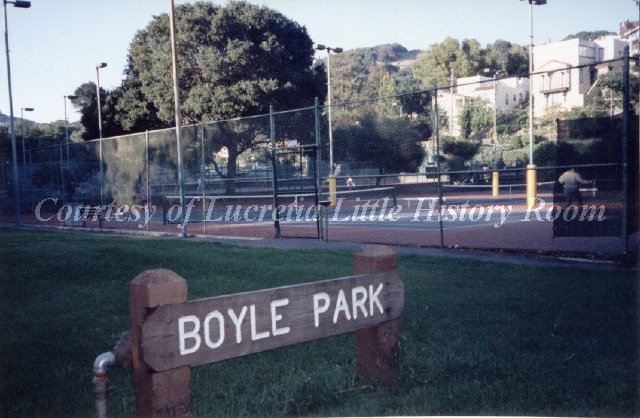
The article also took a hard look next door. It called the Boyle Park courts, which it dated to the early 1930s, “the stepsister of Marin tennis facilities”, old and in need of complete rebuilding, and reported a fund-raising campaign that had already collected $75,0005. (The Record of 1938 shows the city's first three courts were opened that June; the article's date is probably a loose one.) The library's photographs of December 2016 show the result: new courts and a small tennis centre with a patio, beside Warner Creek6,7.
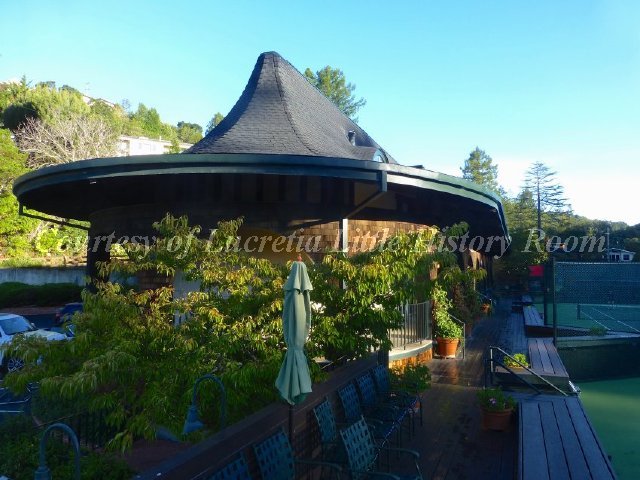
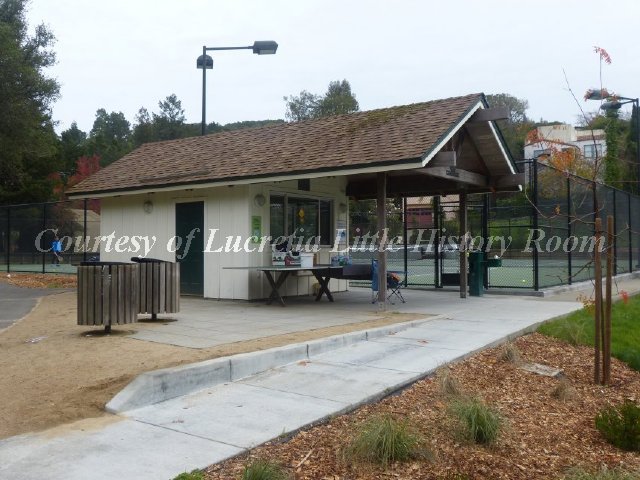
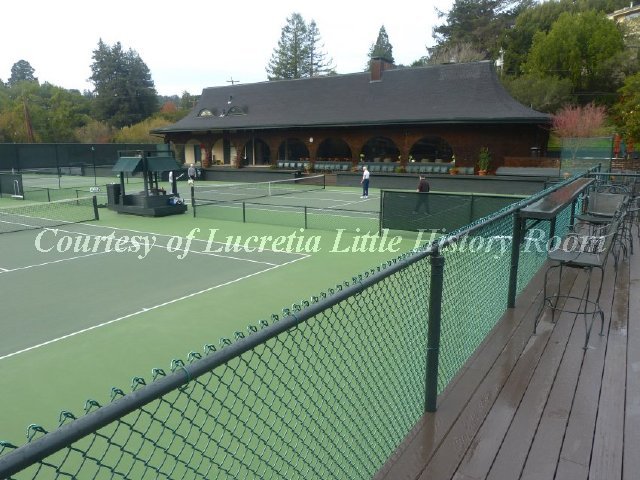
The club rebuilt too. The library's photographs of October 2016 show its “recently finished clubhouse” at 285 Manor Drive in a classic shingle style10. The papers read for this history do not describe the project. A further set taken that December shows the clubhouse from Manor Drive, the patio, and the courts below it11,12,13.
A local columnist walking up Warner Creek in 2004 had noticed what the founders had done to it. The creek, he wrote, passes under the club's parking lot and grounds in a big culvert; to the club's builders it had been an inconvenience, and they buried it9. The founders' program of November 1929 had indeed begun with culverting or filling the creek14, and in 1947 the city laid culvert pipe in the open ditch between the clubhouse and the Manor Drive bridge15.
The club stayed small on purpose. Its website describes a not-for-profit club, founded in 1929, with a strong family tradition and teams in leagues across Marin, Sonoma and the Bay Area16. A Google summary of its membership page says membership is kept low to avoid crowding the clubhouse, courts and pool17. The waiting list the founders started in 1929 is still part of the club's reputation; a 2026 guide to Marin clubs, known only from its search snippet, advises newcomers to put their names down as soon as they are serious about the town17.
From Seniors to Championships
In 2014 the tournament changed its name from the Marin Seniors to the Marin Championships, the brochure says, to recognize its larger scale; its divisions run from the 30s to the 85s, players come from New York, Florida, Texas and a dozen other states, and prize money is about $25,0001. It has several times been named the NorCal Senior Tournament of the Year, three times in the six years before 20241; the Independent Journal gave the years as 2016, 2018 and 201918. The brochure credits the member volunteers, and lists the tournament chairs: Bob Seymour, Dick Dresel, Marilyn Stevens, Jani Ross, Susan McShannock, Chrissie Costamagna and Susan Tighe1.
The pandemic stopped it for three years. In May 2023 the Independent Journal announced that the 47th edition, under the name Mill Valley Championships, would return in June after a three-year hiatus due to COVID, with matches also at Harbor Point and the Scott Valley Swim and Tennis Club and $25,000 in prize money18. The tournament director, Chrissie Costamagna, said it was one of the oldest national tournaments, and so exciting to be back18. Geoff Martinez, a former Marin Academy coach, had won his age group there more than ten times18.
The tournament's own roll of champions for 2025 lists singles winners in every five-year age group from the 30s to the 85s, among them Dan Hiddleson in both the 45s and the 50s19. The Independent Journal reported that Hiddleson, of Larkspur, had beaten Bo Lal in a three-set 50s final that year, and that the tournament ranked among the top ten USTA adult tournaments in the country20. Lal, who had played it nearly every year since turning 35, said the prize money came first, and that it was “our own tournament”20.
The Fiftieth
As the club approached its hundredth birthday, the Independent Journal wrote in April 2026, the Marin Championships were getting the party started early with their fiftieth edition, June 2 to 7, at the club, Harbor Point and the Belvedere Tennis Club; a record 300 players had competed the year before, in age flights from 35 to 8520. Susan McShannock, director for nearly thirty years, said the club had a tradition and cachet different from most because of its history20. Costamagna, director since 2015 and president of USTA Northern California, ran it with the longtime member Susan Tighe20.
In May the city council issued a proclamation honouring the tournament, a national Level 2 event sanctioned by the USTA, and commending the club and its partners, Harbor Point, Belvedere and formerly Scott Valley22,23. Mayor Max Perrey told his colleagues that his grandparents had been members in 1959, when they bought a house uphill from the club, the house where his mother and he later grew up22.
The fiftieth drew a record 373 entries from twelve states, and the prize money was raised to $32,00024. The council and the Patch report had put the purse at about $25,00022. The club held a dinner on the Friday, with the French Open on the big screen in the clubhouse24. The men's 30 singles final, played at the club on Sunday 7 June, was an all-Marin Academy affair: Ben Barad, unseeded and home from Vancouver for his mother's seventieth birthday, beat the top seed Shayan Shooshtarian 7–5, 6–3, and won $40024. Bo Lal, the professional at the Mount Tamalpais Racquet Club, won the 50s singles and two mixed doubles titles; Louis Ramirez of Mill Valley won the men's 80 singles24.
Ninety-six years after a doctor went looking for a lot to build one court, the club that grew out of that errand had hosted Helen Wills Moody and Don Budge, built a pool that a founder's champion daughter dedicated, survived a Depression that by its own account left only two of the private clubs of 1929 in southern Marin, and seen its June tournament proclaimed a point of pride for the city25,22.
Notes to Chapter VI (25 sources)
- Mill Valley Tennis Club, 2024 Marin Championships tournament brochure, with Jim Tighe's “History of the Marin Championships” (May 2024; mvtc.org PDF; text copy research/pdf/marin_champs_2024.txt). view source ↗
- Mill Valley Herald, June 29, 2004. view source ↗
- Mill Valley Herald, Aug. 30, 1999. view source ↗
- “Marin briefs: Mill Valley’s Cowan to compete in international tennis competition,” Marin Independent Journal, Oct. 8, 2008 (saved copy research/web/004.html; link is a search for the page). view source ↗
- Holly Woolard (column), “Tennis in Marin: County brimming with tennis history,” Marin Independent Journal, March 21, 2011 (saved copy research/web/000.html; link is a search for the page). view source ↗
- Mill Valley Public Library, Lucretia Little History Room, Boyle Park sign and tennis courts, 2016, object 2016.015.364. view source ↗
- Mill Valley Public Library, Lucretia Little History Room, Boyle Park tennis center, 2016, object 2016.015.365. view source ↗
- Mill Valley Public Library, Lucretia Little History Room, Boyle Park tennis courts and Warner Creek, 2016, object 2016.015.368. view source ↗
- Mill Valley Herald, May 4, 2004. view source ↗
- Mill Valley Public Library, Lucretia Little History Room, Mill Valley Tennis Club exterior, 2016, object 2016.015.347. view source ↗
- Mill Valley Public Library, Lucretia Little History Room, Mill Valley Tennis Club clubhouse, 2016, object 2016.015.378. view source ↗
- Mill Valley Public Library, Lucretia Little History Room, Mill Valley Tennis Club patio, 2016, object 2016.015.379. view source ↗
- Mill Valley Public Library, Lucretia Little History Room, Mill Valley Tennis Club tennis courts, 2016, object 2016.015.380. view source ↗
- Mill Valley Record, Nov. 15, 1929. view source ↗
- Mill Valley Record, Nov. 21, 1947. view source ↗
- Mill Valley Tennis Club, home page, “About Us” (mvtc.org; saved copy research/web_mvtc/000.html). view source ↗
- Google search result for melissainmarin.com, “Marin Tennis, Swim & Golf Clubs: Waitlists & Fees (2026)” (known from the search snippet only; research/google1.txt). view source ↗
- “Mill Valley Championships back on the tennis calendar,” Marin Independent Journal, May 8, 2023 (saved copy research/web/007.html; link is a search for the page). view source ↗
- Marin Championships, “Roll of Champions” (2025 results), marinchampionships.com (saved copy research/web/003.html). view source ↗
- “Tennis: Clubs gearing up for 50th edition of Marin Championships,” Marin Independent Journal, April 25, 2026 (saved copy research/web/005.html; link is a search for the page). view source ↗
- “Tennis: Mill Valley standout … earns USTA honor,” Marin Independent Journal, March 2, 2025 (known from a Google search snippet only; research/google1.txt). view source ↗
- “Marin Championships Tennis Tournament 50th Anniversary Honored At City Council Meeting,” Mill Valley Patch, May 28, 2026 (saved copy research/web/008.html; link is a search for the page). view source ↗
- “Council proclaims 50th Marin championships, commends Mill Valley Tennis Club,” Citizen Portal summary of the Mill Valley City Council meeting, May 2026 (saved copy research/web/001.html; link is a search for the page). view source ↗
- “Tennis: All-Marin Academy final highlights 50th Marin Championships,” Marin Independent Journal, June 7, 2026 (saved copy research/web/006.html; link is a search for the page). view source ↗
- Mill Valley Record, Aug. 8, 1946. view source ↗